The short version
- Federal minimums for hazmat carriers are $1,000,000 for oil, hazardous materials and substances not in the top tier, and $5,000,000 for certain bulk hazardous materials such as bulk Division 2.1 or 2.3 Zone A, explosives 1.1 to 1.3, and highway route controlled radioactive quantities.
- The hazmat tiers apply to private carriers as well as for-hire carriers, and to intrastate bulk shipments, not only interstate freight.
- Anyone transporting a placarded quantity of hazmat generally must register with PHMSA each year under 49 CFR 107.601, and some materials also require an FMCSA hazardous materials safety permit.
- The MCS-90 treats environmental restoration as public liability, so spill cleanup can land on the insurer and then back on you unless your policy covers pollution from the cargo.
Who this page is for
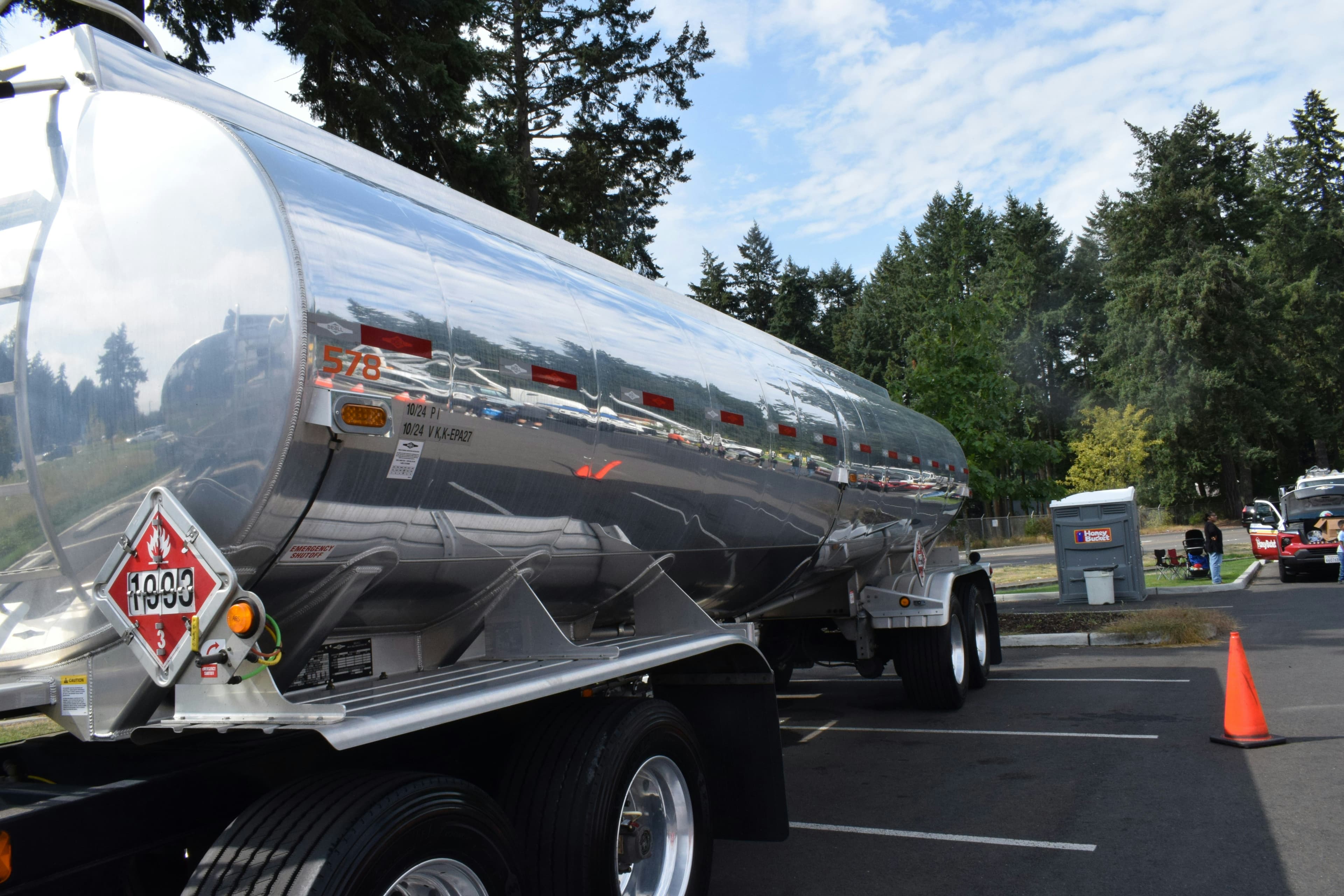
This is for Texas carriers that haul placarded loads: fuel and petroleum transports, chemical tankers out of the Houston and Beaumont plants, LPG and propane haulers, carriers moving hazmat in drums and totes on vans and flatbeds, and hazardous waste transporters. See the Houston and Beaumont location pages for the Gulf Coast context, and tanker truck insurance for tank-specific issues.
Hazmat changes three things at once: the federal limit you must carry, the registrations you must hold, and how much the pollution exclusion on a standard auto policy matters.
The 49 CFR 387.9 hazmat tiers
The schedule of limits in 49 CFR 387.9 has four rows. Three involve hazardous materials:
| Type of carriage | Commodity | Minimum |
|---|---|---|
| For-hire, interstate or foreign; 10,001+ lbs | Non-hazardous property | $750,000 |
| For-hire and private; interstate, foreign or intrastate; 10,001+ lbs | Hazardous substances in bulk in cargo tanks, portable tanks or hoppers; Division 1.1, 1.2, 1.3; Division 2.1 or 2.2 in bulk; Division 2.3 Zone A or 6.1 PG I Zone A; highway route controlled Class 7 | $5,000,000 |
| For-hire and private; interstate or foreign in any quantity, or intrastate in bulk only; 10,001+ lbs | Oil listed in 49 CFR 172.101, hazardous waste, hazardous materials and hazardous substances not in the $5M row | $1,000,000 |
| For-hire and private; interstate or foreign; under 10,001 lbs | Division 1.1 to 1.3; Division 2.3 Zone A or 6.1 PG I Zone A; highway route controlled Class 7 | $5,000,000 |
How a trucking liability tower stacks
Private carriers are in scope
The two hazmat tiers that cover large trucks apply to "for-hire and private" carriers. A distributor or contractor hauling its own fuel or chemicals in bulk is subject to the same minimums as a for-hire tanker carrier.
Registrations and permits that sit next to the policy
These are not insurance, but underwriters and shippers check them, and a lapse can stop a load:
- PHMSA hazmat registration (49 CFR 107.601). Anyone who offers or transports, among other things, any quantity of hazmat that requires placarding, a bulk shipment of 3,500 gallons or more of liquid or gas, or 5,000 pounds or more gross of one placarded hazard class in non-bulk packages, must register annually and pay a fee. Some farm-related shipments are excepted.
- FMCSA hazardous materials safety permit (49 CFR 385.403). Required for specific materials, including highway route controlled quantities of Class 7, more than 25 kg of Division 1.1 to 1.3 explosives, certain materials poisonous by inhalation, and liquefied gas with at least 85 percent methane in bulk packaging of 3,500 gallons or more.
- CDL endorsements (49 CFR 383.93). Drivers transporting hazardous materials need the hazardous materials endorsement, and tank vehicle work has its own endorsement.
- Federal and Texas filings. Your insurer files proof of the higher limit with FMCSA or TxDMV. See FMCSA and TxDMV filings and the BMC-91X filing.
Which filing goes where
Pollution: the MCS-90 and the exclusion
Under 49 CFR 387.5, public liability "includes liability for environmental restoration," defined to cover restitution for damage to natural resources from an accidental discharge, plus removal costs. The MCS-90 endorsement guarantees the public that the insurer will pay up to the required limit for public liability.
The catch is that the MCS-90 is a promise to the public, not coverage for you. If the underlying policy excludes pollution from the cargo (most standard auto forms do), the insurer can pay under the MCS-90 and then seek reimbursement from you. See what an MCS-90 is.
Hazmat carriers close that gap with the ISO broadened pollution endorsement for covered autos (CA 99 48) or a separate transportation pollution policy, and should confirm the umbrella does not exclude pollution. See truck pollution liability and trucking umbrella insurance.
What underwriters weigh, and the common gaps
Underwriters weigh hazard class and packaging (bulk versus non-bulk), tank construction, driver hazmat experience, loading and unloading procedures at plants and terminals, routing through populated areas, and the carrier's hazmat inspection and violation history. See how CSA scores affect insurance.
| Requirement | Where the gap usually is |
|---|---|
| $5M for bulk Division 2.1 or other top-tier materials | Policy and filing at $1M because the commodity list was not updated |
| Pollution from cargo covered | No CA 99 48 or pollution policy; full MCS-90 reimbursement exposure |
| Umbrella follows form | Umbrella excludes pollution or hazmat |
| Loading and unloading at plants | No coverage for releases during transfer through the truck’s pump or hoses |
| PHMSA registration current | Registration year lapsed; shipper onboarding flags it |
| Drivers qualified | New driver without hazmat endorsement dispatched on a placarded load |
Before you add a new hazmat commodity
The most expensive hazmat gap we see is a carrier that was correctly insured for the freight it hauled at the last renewal and then took on a new commodity mid-term. A fuel carrier that starts hauling propane, or a van carrier that starts taking placarded drums, can move into a different 387.9 tier without anyone telling the insurer.
Before the first load of a new commodity:
- Classify it. Get the shipping description and hazard class from the shipper, and confirm whether it is bulk or non-bulk.
- Find the 387.9 row. Bulk Division 2.1 flammable gas, for example, sits in the $5,000,000 row, while most other placarded loads sit in the $1,000,000 row.
- Tell your agent. The policy limit, the commodity list on the application and the federal or Texas filing may all need to change.
- Check registrations. Confirm PHMSA registration is current and whether the material needs an FMCSA safety permit.
- Check drivers. Every driver dispatched on the load needs the hazmat endorsement, and tank work needs the tank endorsement.
Send the shipper's requirements and your current declarations through the review form and we will check the fit.
Common questions
How much liability insurance does a hazmat carrier need?
Under 49 CFR 387.9, $1,000,000 for oil, hazardous waste and most hazardous materials, and $5,000,000 for certain bulk hazardous materials, explosives, inhalation hazards and highway route controlled radioactive material.
Do hazmat insurance minimums apply to intrastate carriers?
Yes, in part. The $5M tier applies to interstate, foreign or intrastate commerce, and the $1M tier applies to intrastate shipments in bulk. Part 387 applies to hazmat transport whether or not it crosses state lines.
Who must register with PHMSA?
Under 49 CFR 107.601, generally anyone who offers or transports hazmat in a quantity that requires placarding, a bulk shipment of 3,500 gallons or more, or 5,000 pounds gross of one placarded class, among other triggers.
Does the MCS-90 cover my spill cleanup?
It guarantees payment to the public for public liability, including environmental restoration. If your policy excludes cargo pollution, the insurer can seek reimbursement from you. Pollution coverage on the policy itself is what protects you.
Do private fleets hauling their own fuel need hazmat limits?
Yes. The hazmat rows in 49 CFR 387.9 apply to for-hire and private carriers.
Sources
- 49 CFR 387.9, Financial responsibility, minimum levels. Schedule of limits, including the $1M and $5M hazmat tiers and private carrier scope.
- 49 CFR 387.3, Applicability. Hazmat carriers covered in interstate, foreign or intrastate commerce.
- 49 CFR 387.5, Definitions. Public liability includes environmental restoration.
- 49 CFR 107.601, Applicability of registration. PHMSA registration triggers.
- 49 CFR 385.403, Who must hold a safety permit. Materials requiring an FMCSA hazardous materials safety permit.
- 49 CFR 383.93, Endorsements. Hazardous materials and tank vehicle endorsements.
This page explains insurance, not law. Have your attorney review indemnity and contract language; our job is making the insurance match it.
Keep reading
By operation
What insurance does a Texas tanker operation need?
Coverage
Truck pollution liability: when a spill is covered and when it is yours
By operation
What insurance does a Texas oilfield trucking company need?
Questions
What are the FMCSA minimum insurance limits for trucks?
Questions
What is the MCS-90 endorsement?
Locations
What do Beaumont trucking companies need from their insurance?